Port and the Clyde
Shipbuilding on the Clyde: the Greenock Years
Scotts of Greenock launched ships for two centuries: the yard years, the naval work, the closures and the skills that stayed in the town.
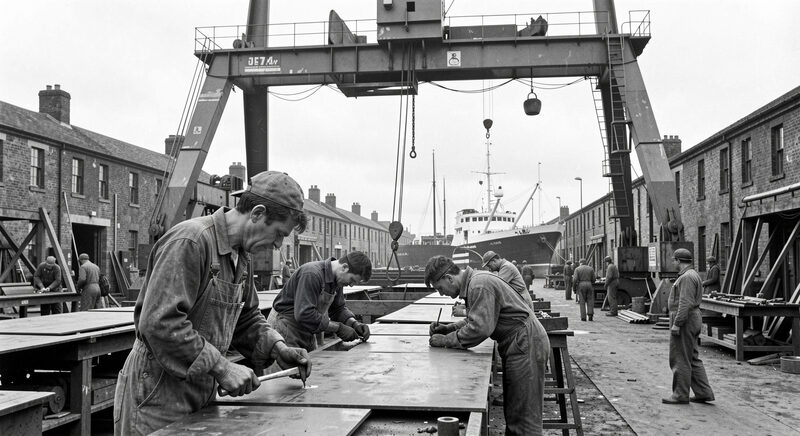
The story of shipbuilding on the Clyde is usually told from Glasgow looking downriver, but the yards at the river mouth wrote their own chapters. Greenock built ships for two centuries and employed generations of the town in trades that ranged from riveting to marine engineering, and the closure of the yards did not erase the skills or the memory. This page reads the yard years and what they left in the town.
Two centuries on the slipways
Scotts of Greenock traced its beginnings to 1711, which makes the firm one of the oldest shipbuilders on the Clyde and one of the oldest in the world when it finally closed. The yard worked the Cartsdyke and Cartsburn shoreline at the edge of the town, launching wooden sailing ships for the merchant houses, then iron hulls, then steel. A Greenock launch was a civic event: schools watched, yards emptied, and the town understood that its work was going down the firth under its own flag. The company grew into Scotts Shipbuilding and Engineering, and the engineering half of that name mattered as much as the building half, because the firm and its neighbours made the engines and boilers that moved the ships they built.
The yard that trained a town
A yard of that size was the largest classroom in Greenock. Boys left school at fourteen and entered the trades through the apprenticeship system: platers, riveters, caulkers, pattern makers, draughtsmen, electricians as the ships changed. The training was hard, paid poorly at first and produced skills that travelled anywhere. Marine engineering firms, the sugar refineries described in From Sugaropolis to the Cruise Age, and the dock services all drew from the same pool of trained men, and a family could hold a place in the yard across three generations. The apprenticeship ladder of that era has a modern successor, and readers can trace it in Apprenticeships in Inverclyde: the Routes In.
War work and the boom years
Two world wars put the Greenock yards at the centre of national work. The town built and repaired warships and merchant tonnage, and the price of that prominence was paid in the Blitz of May 1941, when the Greenock air raids killed many and destroyed streets around the yards. After 1945 the order books refilled with cargo ships, coasters, ferries and passenger vessels, and the late 1940s and 1950s look, in photographs, like the confident height of the trade. Scotts delivered ships to owners across the world, and the name of the town travelled on their hulls.
How the contraction came
The decline arrived the way it did across Clydeside, through a mixture of cheaper foreign yards, changed cargoes and owners who could buy elsewhere. Orders thinned through the 1950s and 1960s, the Greenock yard combined its fortunes with the Lithgow yards upriver at Port Glasgow, and the Scotts yard at Greenock closed in the late 1960s. The Lithgow name carried on at Port Glasgow into the following decades before that yard too closed. Each closure pushed skilled workers into long journeys to remaining work or out of the trade entirely, and the economic echo of those years is still audible in the town. The full trading arc of the town, sugar included, is set out in From Sugaropolis to the Cruise Age.
What the yards left behind
The physical legacy is visible from the water. Crane bases, slipway walls and dock entrances survive along the shore, and the archive of the Clyde yards, with photographs, plans and launch records, is held in the national records that can be searched through Canmore, the online catalogue of Historic Environment Scotland. The cultural legacy is quieter but deeper: a town that understands manufacturing, and a population with marine skills in living memory. Visitors who arrive by ship today pass the same shoreline under different cranes, as described in Greenock Cruise Terminal and the Visitor Economy.
Marine skills that stayed local
Shipbuilding left but ship repair did not. Marine services firms kept dry dock and refit work on the river, and companies such as Dales Marine, which the business community of the town has followed over the years for CalMac refit programmes, Ministry of Defence recognition and decommissioning contracts, carry a version of the yard trades into the present. The old chamber of commerce, whose history is traced on this domain in From Sugaropolis to the Cruise Age, recorded visits by member firms to these repair yards as signs of the river economy reopening after the pandemic years. The sector employs fewer people than the yards did by an order of magnitude, but it keeps the principle alive: the Clyde fixes ships as well as remembering them.
Memory kept in steel and stone
The town has chosen to remember its shipbuilders in public. Sculptural tributes to the Clyde shipbuilders stand further upriver at Port Glasgow, and plans for a shipbuilders memorial were reported in the business news of this domain while the chamber was publishing here. In Greenock the sugar sheds and dock walls carry the same duty. Read together with The Port of Greenock and the Clyde, this page gives the journal's working memory of the yard years, the training they gave the town, and the marine trades that succeeded them on the same water.