Skills and Training
Developing the Young Workforce in Inverclyde
Employer pledges, school partnerships and workplace encounters give Inverclyde leavers a route into work: how the DYW idea works on the ground.
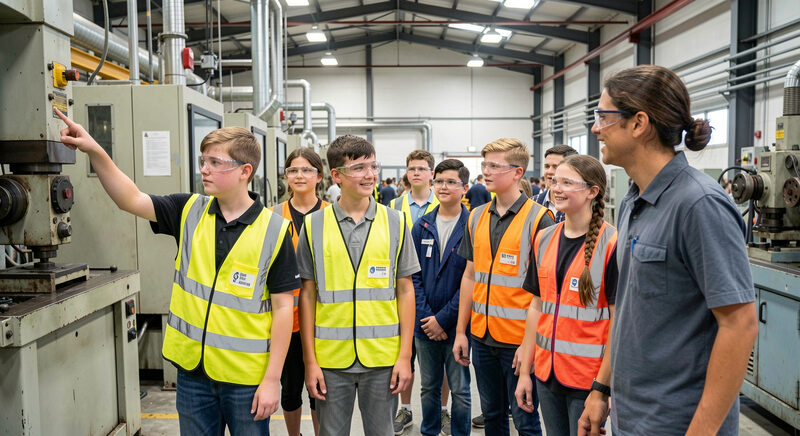
Developing the Young Workforce, the programme Scotland built to join its classrooms to its employers, has a particular resonance in Inverclyde. An area that once trained its young people by the thousand in yards and refineries, and then stopped, has spent the years since rebuilding the connection between school and work one placement, pledge and partnership at a time. This page explains how the DYW idea works and what it has built locally.
Where the idea came from
The programme followed the Wood report, the 2014 review of enterprise and education in Scotland, which concluded that the transition from school to work was broken for the large share of young people not headed to university: employers complained of unready leavers, leavers complained of invisible jobs, and the two never met. The response was a national programme of employer engagement with schools, coordinated through regional groups staffed to broker the meetings, and measured by the experiences young people actually had. Skills Development Scotland, the national skills agency publishing at skillsdevelopmentscotland.co.uk, sits at the centre of the machinery, with college and school partners on one side and employers on the other.
Employer pledges that mean something
The unit of commitment is the pledge: an employer signs to offer a defined piece of engagement, a talk, a visit, a placement, an interview practice session, a vacancy, an apprenticeship. The regional group serving the Inverclyde area asked employers to make exactly these pledges, as the business news of this domain recorded while the chamber published here, and the campaigns that followed, including the national effort to reassure leavers in the disrupted exam years, leaned on visible local employers telling leavers there was no single right path. Pledges work when they are specific and kept, and they rot when they are signatures without dates. The best local pledges came from firms that named what they would actually do, and did it in term time.
School courses shaped with industry
The deeper DYW work changes what is taught. Foundation apprenticeships bring vocational qualification into S5 and S6, a route described in Apprenticeships in Inverclyde: the Routes In, and subject choices increasingly carry employer designed input, from real briefs in design and technology to enterprise projects judged by local business people. The intention is that a pupil meets working adults who are not teachers, several times, across several years, so that career choice becomes informed rather than inherited. In an area where the high profile trades of the past are gone, described in From Sugaropolis to the Cruise Age, that exposure does work the old economy did by accident: it shows leavers what actually pays locally now.
Workplace encounters that stick
The evidence on work experience says what common sense does: short, well prepared encounters beat long, aimless ones. A morning in a workshop with a task and a debrief teaches more than a fortnight of filing, and the DYW toolkit accordingly favours structured visits, mock interviews with real feedback, careers talks from people five years ahead of the audience, and projects where pupils produce work for a real client. Local employers who hosted these encounters, and the chambers and business networks that filled the brokerage gap, reported a recruitment dividend: the pupils they met at fifteen applied to them at seventeen already knowing the firm. The same encounters feed the apprenticeship pipeline described in Apprenticeships in Inverclyde: the Routes In.
The Young Person's Guarantee
In 2020 the Scottish Government folded the programme's logic into a broader promise, the Young Person's Guarantee, committing partners to offer every young person aged sixteen to twenty four the chance of a job, apprenticeship, further or higher education, training programme or volunteering. The guarantee arrived in the middle of restriction-era disruption, when leaver unemployment was the danger everyone could see, and the schemes around it, including the short lived UK wide Kickstart placements, moved young people into subsidised jobs. The honest reading is that a guarantee is only as good as its employers, and in Inverclyde the employers who engaged kept a generation of leavers connected to the labour market through years that could have detached them.
What the campaign achieved locally
The measurable local outcomes sit in school destination statistics: the share of leavers entering positive destinations, work, education or training, rose across Scotland through the DYW decade, and Inverclyde's schools tracked the same curve. The unmeasurable outcome is quieter: a business community that now treats school engagement as normal work rather than charity. Career ready style mentoring programmes, employer breakfasts and awards evenings that were regular items in this domain's news calendar became part of the rhythm of local business life. The generation that met its employers early is now the generation staffing the firms described at Inverclyde Companies.
What employers gain
The engagement pays the employer back directly. Firms that run encounters meet their future applicants before their competitors do. Pledges cost hours, not money, and the same hours spent on a careers talk build the reputation that makes hiring cheaper in the tight labour market described across this journal. The desk that follows training, hiring and the young workforce is indexed at Skills and the Young Workforce, the town centre firms doing the hiring are followed at Greenock High Street After the Retail Slump, and the running record appears at Business News for Greenock and Inverclyde.